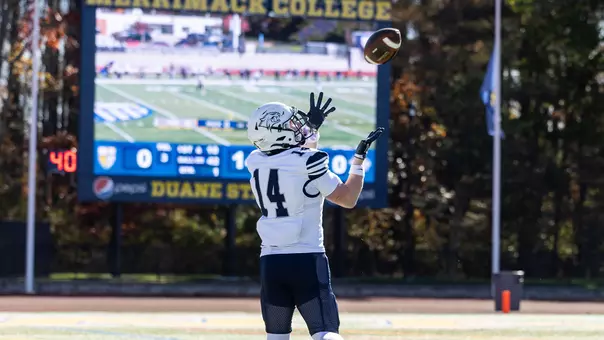
Mailaja Mohammed, a nurse practitioner, and his family proudly support Wildcat football coach Sean McDonnell.
Catching Up with the 'Cats - Mailaja Mohammed
4/29/2020 3:56:00 PM | Football, UNH Insider
Share:
By: Allen Lessels
Mailaja Mohammed, a native of Ghana, moved to the United States at the age of 15 in 1990. He enrolled at the University of New Hampshire as a recruited walk-on out of Brockton, Mass., and Southeast Regional Vocational Technical High School in South Easton, Mass., to play football and with the thought of eventually becoming a veterinarian. Affable and outgoing, Mohammed played cornerback and on special teams for the Wildcats and graduated in 1998 with a degree in animal science with a concentration in dairy management.
"He was engaging and athletic and always had a smile on his face," said Wildcat head football coach Sean McDonnell, who was the offensive coordinator at the time. "Our guys loved him and he really made himself into a very good football player. He was a physical football player, a tough kid. He was a great kid, one of those kids you don't forget. You see what he's done and it's very impressive. It doesn't surprise me what he's doing. He was always very serious about his family, very connected to his family."
After graduation, Mohammed entered the workforce. His path steered him toward a hospital environment and he went on to become a registered nurse and in 2016 graduated from Rivier University in Nashua, N.H., as a nurse practitioner. Mailaja lives with his wife, Rukaiya, and their four children, ages 4 to 13, in Hudson, N.H. We caught up with him for our latest edition of Catching Up with the 'Cats.
What is your job?
I currently work as a family nurse practitioner at two different hospitals. My full-time job is at Southern New Hampshire Medical Center in their outpatient immediate care setting at any one of the seven locations we have in Nashua (two sites), Merrimack, Amherst, Pelham, Hudson and Pepperell, Mass.
I also work on a per diem basis as a hospitalist nurse practitioner at Holy Family Hospital in Methuen, Mass.
What was the process that got you from UNH to here?
My transition from being an animal science major from UNH and now a family nurse practitioner was more due to exposure. After graduating from UNH, the job market in my field was very difficult. Through a job fair at UNH, I was able to get a job with a French company called Sodexo. The company runs the cafeteria, housekeeping and building management in many hospitals and institutions of higher education. I was lucky enough to be placed at Winchester Hospital in Winchester, Mass., as a housekeeping manager. I managed approximately 30 employees during my time there and got to know many staff in the clinical setting.
Through that exposure I got a job in the staffing office as a coordinator who staffed the different floors. I became more motivated to work as a nurse by first becoming an LNA and working in the emergency department as an ED tech for five years.
Through the experience I acquired in the emergency room, I was able to take advantage of a program at Winchester Hospital called the McDonough Fund. The program pays for your nursing education and you in turn have to commit to work for the hospital as a nurse for two years and longer if you wish. I ended up working a total of 17 years at Winchester Hospital and 10 years at Southern New Hampshire Medical Center, all in the emergency room. Four years ago, I obtained my masters in nursing degree as a family nurse practitioner at Rivier University.
What are your work duties?
It depends on where I am working. At the outpatient immediate care setting I take care of patients who come in with many complaints, including suturing of wounds and performing incision and drainage of abscesses. Those that come in with more serious conditions I assess and transfer via ambulance to the emergency department for appropriate care.
When working at Holy Family as a hospitalist, I do rounds on admitted patients, discharge patients that are clinically stable and also do admissions of patients from the emergency room to the appropriate medical floor.
How has the coronavirus pandemic impacted your work?
The impact is very different depending on which location I'm working. With both the immediate care and hospital setting, visitors are not allowed in except in very rare situations like imminent death of a patient when a very limited number family are allowed in for 15 minutes at Holy Family. The population overall has adhered to social distancing and stay-at-home measures which has led to a significant decrease in patient traffic in both the outpatient and inpatient settings. The decrease in patient traffic has led to decreased work and furloughs of some employees which I believe is a tough decision that anyone has to make.
And how has it impacted life away from work?
Both myself and my wife, who is a respiratory therapist for Beth Israel Hospital, have had to adapt to carrying a bag with clean clothing to change into before coming home, especially since we have four young children and one adult at home to protect. My wife is more exposed than I am and one of our biggest fears is catching something and bringing it home to our kids. We put our scrubs in a bag and bring them home to wash. We don't allow the kids to hug us when we come in. We take a shower and change before hugging is allowed. It's scary.
What is the most challenging part of what you do?
It's not knowing who has COVID-19 because of the variation of symptoms different patients present with. So you have to assume anyone that walks in through immediate care or the emergency room before admission to a patient unit is positive until proven otherwise with a test. The test however is not readily available to test every patient that comes through even if symptomatic. We advise of self-quarantine and self-monitoring and go to the emergency room if worsening symptoms.
What is the toughest thing you have to do?
The toughest part is having sick patients without families by their side. Many studies have shown patients in the hospital do well when they have family members around them. In the age of COVID-19 most communications have to be done by phone or video calls which is a very sad thing to see.
What is the most rewarding part of the job?
When you can actually make a person better and send them home is the most rewarding part of the job.
What's a message you'd like to share with people on how to deal with the coronavirus situation?
Listen to the experts and those that are seeing firsthand the destruction this virus is causing families. Take the necessary precautions by wearing a mask and performing proper hand washing.
How did your experiences at UNH help prepare you for what you are doing now?
At UNH, all student-athletes had to learn time management between their studies and athletic commitments which was a lot both during and after football season in my case. Another thing UNH taught me is if your commitment to football and studies become stressful and hard, ask for available help.
What is your best UNH football memory?
Being coached by some of the best (Coach Bowes, Coach Mac, Chip Kelly) and playing with some of the best (J Zoom, Tim Cramsey, Romande Carter, Geoff Boyd, Calvin Jones and too many more to mention.)
When Jerry Azumah came on his recruiting visit I was his host. He was born in the US, but his parents were born in Ghana and I got to know them as well. He was an awesome player to watch especially since he played offense and me being on defense I saw the damage first-hand. We had a bunch of awesome players, including Dan Kreider and Randal Williams, too. 1998 Wildcats
What do you do to take your mind off the pandemic and work when you're at home?
I pray, fast, talk to my mother and hang out with my wife and children.
So do you always have a smile on your face?
Yes. Making people smile is an act of worship. You've got to treat people the way you want to be treated. Previous Catching Up with the 'Cats stories: